Green or Black Mildew Creeping Up the Siding? Why Pressure Alone Won't Fix It
Real estate professionals broadly agree that neutral exterior and interior palettes generate the widest buyer appeal. Neutrals do not alienate buyers who cannot visualize past a bold personal choice, and they photograph well in listing images, which is where most buyer decisions begin.
Popular exterior palettes for 2024 and 2025 have leaned toward warm whites with contrasting dark trim, soft sage greens paired with warm wood accents, and gray-blue tones with crisp white detailing. These combinations feel current without being trend-dependent, which means they will not feel dated within a year.
Neutral Palettes That Sell
When Unique Colors Work in Your Favor
In neighborhoods where homes tend to look similar, a thoughtfully distinct color can make a property stand out in listing searches and in person. The key is contrast within context. A home that reads as intentional and well-maintained in a color that differs from its neighbors gains attention without appearing out of place.
Consulting a color expert or using digital rendering tools to preview color combinations before committing eliminates the guesswork and reduces the risk of a choice that narrows rather than expands buyer interest.
Quick Answer: Those green or black patches climbing your siding are alive. Algae and mildew feed on the film of dirt, pollen, and moisture that collects on exterior walls in Central Florida's heat and humidity, and a pressure washer can knock the visible growth off the surface without touching what's underneath. The roots and spores driven into the texture of the siding often survive the blast, which is why the stains come back within a season, sometimes worse than before. High PSI can also force water behind panels, strip paint, and chew into softer materials like wood or stucco. What actually holds is a low-pressure soft wash with a cleaning solution that kills the organism at the root, then rinses it away without tearing up the surface underneath.
You've probably caught yourself staring at the north side of the house wondering when those streaks showed up. One week the siding looks fine. A few months later there's a greenish haze creeping up from the base, or dark speckled patches spreading under the eaves and around the shaded corners. It's tempting to grab a pressure washer, or call whoever advertises the fastest blast-and-go job, and assume the problem is solved the second the wall looks clean again. But "looks clean" and "is clean" are two different things when you're dealing with a living organism instead of dirt.
Real estate professionals broadly agree that neutral exterior and interior palettes generate the widest buyer appeal. Neutrals do not alienate buyers who cannot visualize past a bold personal choice, and they photograph well in listing images, which is where most buyer decisions begin.
Popular exterior palettes for 2024 and 2025 have leaned toward warm whites with contrasting dark trim, soft sage greens paired with warm wood accents, and gray-blue tones with crisp white detailing. These combinations feel current without being trend-dependent, which means they will not feel dated within a year.
Neutral Palettes That Sell
When Unique Colors Work in Your Favor
In neighborhoods where homes tend to look similar, a thoughtfully distinct color can make a property stand out in listing searches and in person. The key is contrast within context. A home that reads as intentional and well-maintained in a color that differs from its neighbors gains attention without appearing out of place.
Consulting a color expert or using digital rendering tools to preview color combinations before committing eliminates the guesswork and reduces the risk of a choice that narrows rather than expands buyer interest.
What's Actually Growing on Your Siding
The green film most homeowners notice is typically algae. It feeds on moisture and organic debris rather than the siding material itself, and it spreads as a thin, uneven haze more than distinct spots. The darker splotches, sometimes black, sometimes a dull gray-green, are usually mildew or mold, a fungus that lives on the grime and pollen film that builds up on exterior surfaces over time. Both are opportunists. Give them a damp surface, some shade, and a little organic dust to eat, and Central Florida hands them all three without much effort.
Here's the part people miss: these organisms don't just sit on top of the siding like dust you could wipe off with a dry cloth. Mildew and mold send out microscopic root structures called hyphae that anchor into any texture or porosity the surface offers. Vinyl siding with a wood-grain finish, stucco, fiber cement, painted wood, all of it has enough surface irregularity for those roots to grip into. That's the detail that changes how you have to think about cleaning it. You're not lifting a stain off a smooth plate. You're trying to pull something out that has physically rooted itself into the material.
Real estate professionals broadly agree that neutral exterior and interior palettes generate the widest buyer appeal. Neutrals do not alienate buyers who cannot visualize past a bold personal choice, and they photograph well in listing images, which is where most buyer decisions begin.
Popular exterior palettes for 2024 and 2025 have leaned toward warm whites with contrasting dark trim, soft sage greens paired with warm wood accents, and gray-blue tones with crisp white detailing. These combinations feel current without being trend-dependent, which means they will not feel dated within a year.
Neutral Palettes That Sell
When Unique Colors Work in Your Favor
In neighborhoods where homes tend to look similar, a thoughtfully distinct color can make a property stand out in listing searches and in person. The key is contrast within context. A home that reads as intentional and well-maintained in a color that differs from its neighbors gains attention without appearing out of place.
Consulting a color expert or using digital rendering tools to preview color combinations before committing eliminates the guesswork and reduces the risk of a choice that narrows rather than expands buyer interest.
Why Florida's Climate Practically Grows This for You
If you've lived in Polk County longer than a summer, you already know why this happens here more than almost anywhere else. Heat, humidity, and afternoon storms cycle through nearly every day, and that combination is close to ideal for algae and mildew. Walls dry slowly after rain, especially on shaded sides of the house, under covered porches, or near landscaping thick enough to block airflow. Sprinklers that spray the base of the siding add one more layer of near-constant dampness right where growth likes to start.
Shade does the rest of the work. North-facing walls and spots tucked behind trees, fences, or a neighbor's house get less direct sun, so they stay wet longer after every storm or heavy morning dew. That lingering dampness is exactly what algae and mildew need to establish and spread. It's why the growth usually piles up on one side of the house while the sun-baked side stays comparatively clean. That pattern isn't random. It's a direct map of where moisture sits the longest.
Real estate professionals broadly agree that neutral exterior and interior palettes generate the widest buyer appeal. Neutrals do not alienate buyers who cannot visualize past a bold personal choice, and they photograph well in listing images, which is where most buyer decisions begin.
Popular exterior palettes for 2024 and 2025 have leaned toward warm whites with contrasting dark trim, soft sage greens paired with warm wood accents, and gray-blue tones with crisp white detailing. These combinations feel current without being trend-dependent, which means they will not feel dated within a year.
Neutral Palettes That Sell
When Unique Colors Work in Your Favor
In neighborhoods where homes tend to look similar, a thoughtfully distinct color can make a property stand out in listing searches and in person. The key is contrast within context. A home that reads as intentional and well-maintained in a color that differs from its neighbors gains attention without appearing out of place.
Consulting a color expert or using digital rendering tools to preview color combinations before committing eliminates the guesswork and reduces the risk of a choice that narrows rather than expands buyer interest.
Why Blasting It With a Pressure Washer Falls Short
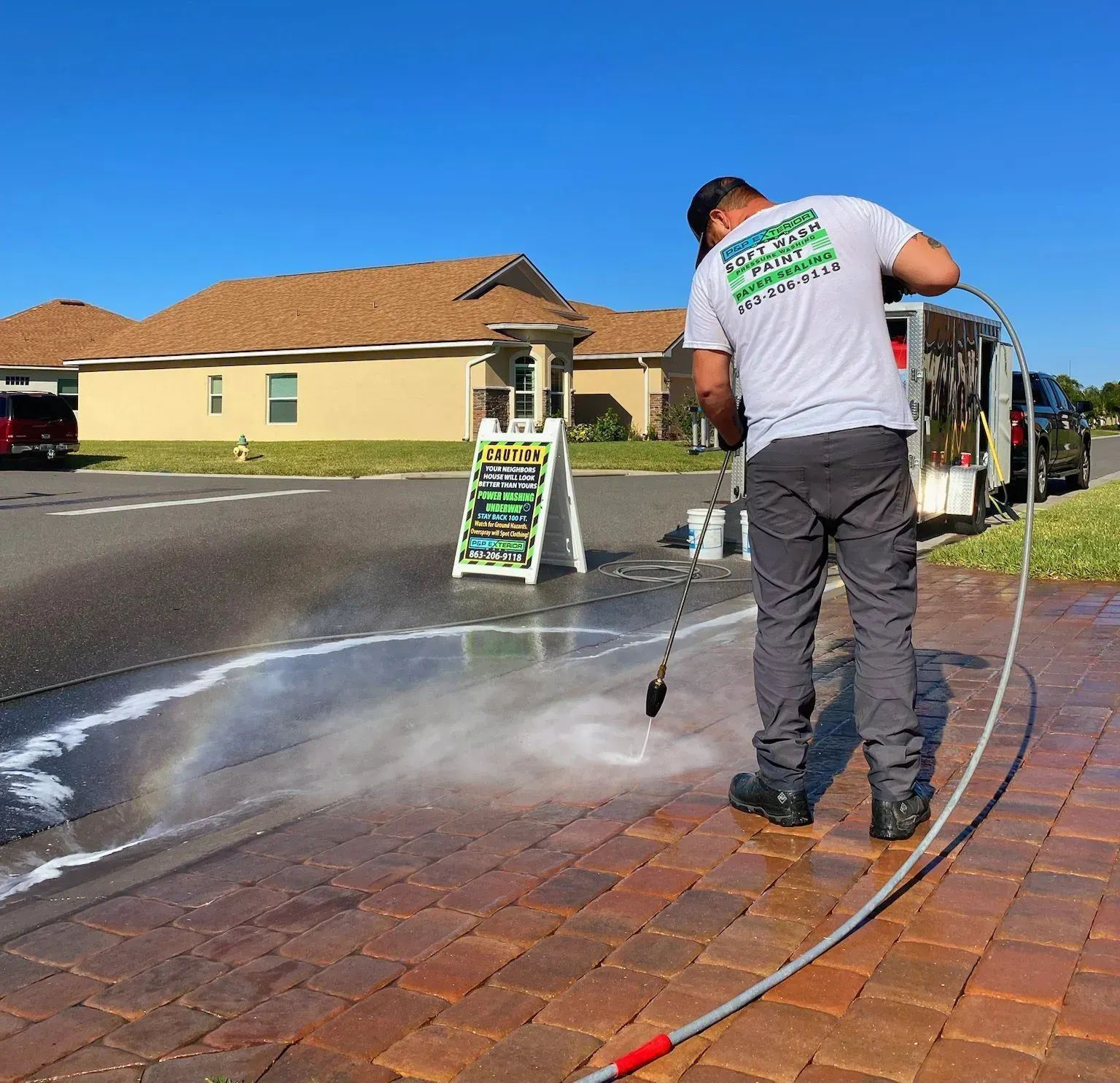
This is where most DIY attempts, and honestly a lot of lower-end cleaning outfits, get it wrong. A pressure washer set to high PSI can strip visible algae and mildew right off the surface of your siding. It looks great for a few weeks. The problem is what's left behind, and what got pushed in deeper than it started.
High-pressure water doesn't tell the difference between surface growth and the material underneath it. On textured or porous siding, that force can drive water and organic matter deeper into the grain, into seams between panels, and behind trim where it has no easy way to dry back out. Trapped moisture sitting behind siding is exactly the environment mold thrives in, except now it's somewhere you can't see it and can't treat it. You've traded a visible cosmetic problem for a hidden one.
And there's the matter of what pressure alone does to the organism itself. Blasting the surface removes the part of the growth you can see. It doesn't reliably kill the roots anchored into the material's texture, and it does nothing about the airborne spores drifting in from nearby trees, roofs, and neighboring homes that will simply resettle on a clean, damp wall. A rinsed surface with surviving spores and roots is primed to regrow, often faster than before, because the water also roughened up the texture it was blasting against.
Warning: Pushing the PSI too high on vinyl siding, older paint, caulking, or softer wood trim can crack panels, strip paint down to bare material, force water past seams into the wall cavity, and void manufacturer warranties on the siding itself. Once water gets behind panels, the damage that follows is usually more expensive and more disruptive than the mildew ever was.
Real estate professionals broadly agree that neutral exterior and interior palettes generate the widest buyer appeal. Neutrals do not alienate buyers who cannot visualize past a bold personal choice, and they photograph well in listing images, which is where most buyer decisions begin.
Popular exterior palettes for 2024 and 2025 have leaned toward warm whites with contrasting dark trim, soft sage greens paired with warm wood accents, and gray-blue tones with crisp white detailing. These combinations feel current without being trend-dependent, which means they will not feel dated within a year.
Neutral Palettes That Sell
When Unique Colors Work in Your Favor
In neighborhoods where homes tend to look similar, a thoughtfully distinct color can make a property stand out in listing searches and in person. The key is contrast within context. A home that reads as intentional and well-maintained in a color that differs from its neighbors gains attention without appearing out of place.
Consulting a color expert or using digital rendering tools to preview color combinations before committing eliminates the guesswork and reduces the risk of a choice that narrows rather than expands buyer interest.
The Difference Chemistry Makes
Soft washing works from the opposite direction. Instead of leaning on mechanical force, it uses a low-pressure application, similar in impact to a garden hose, to apply a cleaning solution built to kill algae, mildew, and mold at the cellular level. The solution dwells on the surface long enough to reach the same texture and porosity the organism rooted into, breaking the growth down from underneath instead of just knocking the top layer loose.
Because the treatment kills the organism instead of merely disturbing it, the surface isn't just clean-looking when the rinse finishes. It's biologically dead. That's the whole reason a properly soft-washed exterior stays noticeably cleaner far longer than one that got blasted with straight water. You're not racing surviving spores trying to reestablish on a freshly roughened surface. You've actually removed what was feeding them.
Tip: If green or black growth comes back within just a few weeks of a cleaning, that's usually a sign pressure alone did the job instead of a biocide-based soft wash. Done right, with proper dwell time, a soft wash should hold up far longer, often well past a single Florida wet season.
Real estate professionals broadly agree that neutral exterior and interior palettes generate the widest buyer appeal. Neutrals do not alienate buyers who cannot visualize past a bold personal choice, and they photograph well in listing images, which is where most buyer decisions begin.
Popular exterior palettes for 2024 and 2025 have leaned toward warm whites with contrasting dark trim, soft sage greens paired with warm wood accents, and gray-blue tones with crisp white detailing. These combinations feel current without being trend-dependent, which means they will not feel dated within a year.
Neutral Palettes That Sell
When Unique Colors Work in Your Favor
In neighborhoods where homes tend to look similar, a thoughtfully distinct color can make a property stand out in listing searches and in person. The key is contrast within context. A home that reads as intentional and well-maintained in a color that differs from its neighbors gains attention without appearing out of place.
Consulting a color expert or using digital rendering tools to preview color combinations before committing eliminates the guesswork and reduces the risk of a choice that narrows rather than expands buyer interest.
Why the Right Pressure Level Matters as Much as the Chemistry
Soft washing isn't just "low pressure" for the sake of being gentle. The pressure level gets calibrated specifically to protect the siding material while still letting the cleaning solution go on evenly and rinse off completely once it's done its work. Vinyl, stucco, fiber cement, and painted wood each react differently to water pressure and chemical exposure, and a professional adjusts both the pressure and the dwell time to match what that particular surface can take.
This matters because siding that's been pressure washed aggressively, even once, often ends up more vulnerable to future growth. Micro-abrasions in the surface, stripped protective coatings, roughened texture, all of it gives algae and mildew more places to grab onto the next time around. A soft wash avoids creating that damage in the first place. You're not just cleaning the siding once. You're keeping the surface in a condition that resists the next wave of spores drifting in from the yard next door.
Real estate professionals broadly agree that neutral exterior and interior palettes generate the widest buyer appeal. Neutrals do not alienate buyers who cannot visualize past a bold personal choice, and they photograph well in listing images, which is where most buyer decisions begin.
Popular exterior palettes for 2024 and 2025 have leaned toward warm whites with contrasting dark trim, soft sage greens paired with warm wood accents, and gray-blue tones with crisp white detailing. These combinations feel current without being trend-dependent, which means they will not feel dated within a year.
Neutral Palettes That Sell
When Unique Colors Work in Your Favor
In neighborhoods where homes tend to look similar, a thoughtfully distinct color can make a property stand out in listing searches and in person. The key is contrast within context. A home that reads as intentional and well-maintained in a color that differs from its neighbors gains attention without appearing out of place.
Consulting a color expert or using digital rendering tools to preview color combinations before committing eliminates the guesswork and reduces the risk of a choice that narrows rather than expands buyer interest.
Keeping Growth From Coming Right Back
Killing what's already there is step one. Slowing how fast it returns is step two, and a few habits around the property make a real difference in a climate this humid. Trimming back trees, shrubs, and hedges that shade the siding lets more sun hit the walls and shortens how long they stay wet after rain. Redirecting sprinkler heads so they aren't soaking the base of the house day after day removes one of the most reliable moisture sources feeding growth at ground level.
Gutters matter too. Clogged or overflowing gutters send water sheeting straight down the siding every time it rains, which keeps whole sections of the wall wet far longer than they should be. Keeping them clear lets water shed the way it's supposed to instead of soaking into the exterior. None of this makes a home immune to airborne spores forever, since they're drifting in from every direction in the neighborhood. But it does meaningfully stretch out how long a properly soft-washed exterior keeps looking the way it did the day it was cleaned.
Real estate professionals broadly agree that neutral exterior and interior palettes generate the widest buyer appeal. Neutrals do not alienate buyers who cannot visualize past a bold personal choice, and they photograph well in listing images, which is where most buyer decisions begin.
Popular exterior palettes for 2024 and 2025 have leaned toward warm whites with contrasting dark trim, soft sage greens paired with warm wood accents, and gray-blue tones with crisp white detailing. These combinations feel current without being trend-dependent, which means they will not feel dated within a year.
Neutral Palettes That Sell
When Unique Colors Work in Your Favor
In neighborhoods where homes tend to look similar, a thoughtfully distinct color can make a property stand out in listing searches and in person. The key is contrast within context. A home that reads as intentional and well-maintained in a color that differs from its neighbors gains attention without appearing out of place.
Consulting a color expert or using digital rendering tools to preview color combinations before committing eliminates the guesswork and reduces the risk of a choice that narrows rather than expands buyer interest.
Frequently Asked Questions
Is the green stuff on my siding actually mold, or just algae?
Green growth is usually algae, which thrives on moisture and organic debris. Mold and mildew typically appear darker, often black or gray-green. Both favor damp, shaded siding and may sometimes grow together across the same exterior areas.
Why does the mildew always come back on the same section of siding?
Mildew often returns where siding stays damp longest, especially shaded walls, areas beneath overhangs, or sections near thick landscaping. If previous pressure washing left spores behind, favorable moisture conditions can quickly encourage growth to return again.
Can I just turn up the pressure washer to make sure it's really gone?
Higher pressure can damage siding rather than solve the problem. It may strip paint, crack vinyl, or push water behind panels. Pressure also may leave organic growth behind, allowing algae or mildew to return after cleaning.
How long should a properly cleaned exterior stay free of algae and mildew?
Results vary depending on shade, humidity, landscaping, and moisture exposure. A properly performed soft wash generally keeps siding cleaner longer than pressure alone. Heavily shaded or consistently damp sections may naturally develop new growth sooner afterward.
Do I need to treat the whole house, or just the spots with visible mildew?
Treating the entire exterior provides more consistent results because airborne spores can settle beyond visibly affected areas. A complete soft wash addresses existing growth and less noticeable buildup, helping the siding maintain a more uniformly clean appearance longer.
Real estate professionals broadly agree that neutral exterior and interior palettes generate the widest buyer appeal. Neutrals do not alienate buyers who cannot visualize past a bold personal choice, and they photograph well in listing images, which is where most buyer decisions begin.
Popular exterior palettes for 2024 and 2025 have leaned toward warm whites with contrasting dark trim, soft sage greens paired with warm wood accents, and gray-blue tones with crisp white detailing. These combinations feel current without being trend-dependent, which means they will not feel dated within a year.
Neutral Palettes That Sell
When Unique Colors Work in Your Favor
In neighborhoods where homes tend to look similar, a thoughtfully distinct color can make a property stand out in listing searches and in person. The key is contrast within context. A home that reads as intentional and well-maintained in a color that differs from its neighbors gains attention without appearing out of place.
Consulting a color expert or using digital rendering tools to preview color combinations before committing eliminates the guesswork and reduces the risk of a choice that narrows rather than expands buyer interest.
A Cleaner Exterior That Stays Protected Longer
Green algae and dark mildew are more than surface stains when they settle into siding. Removing the visible growth without addressing what remains underneath often leads to the same discoloration returning. With 15 years of experience, P&P Exterior Wash, LLC provides knowledgeable exterior cleaning throughout Polk County, FL, using soft washing methods that target organic growth while respecting the siding material. The combination of appropriate cleaning solutions and controlled pressure helps restore a cleaner appearance without unnecessary surface damage.
Long-term results also depend on understanding why certain areas develop growth faster than others. Shade, lingering moisture, overflowing gutters, nearby vegetation, and sprinkler exposure can all create conditions where algae and mildew return. Proper
soft washing
addresses existing buildup without relying on aggressive pressure that may compromise siding, paint, or seals. When exterior surfaces are cleaned with the right balance of chemistry, dwell time, and gentle rinsing, they can remain cleaner while preserving their finish, texture, and overall condition.